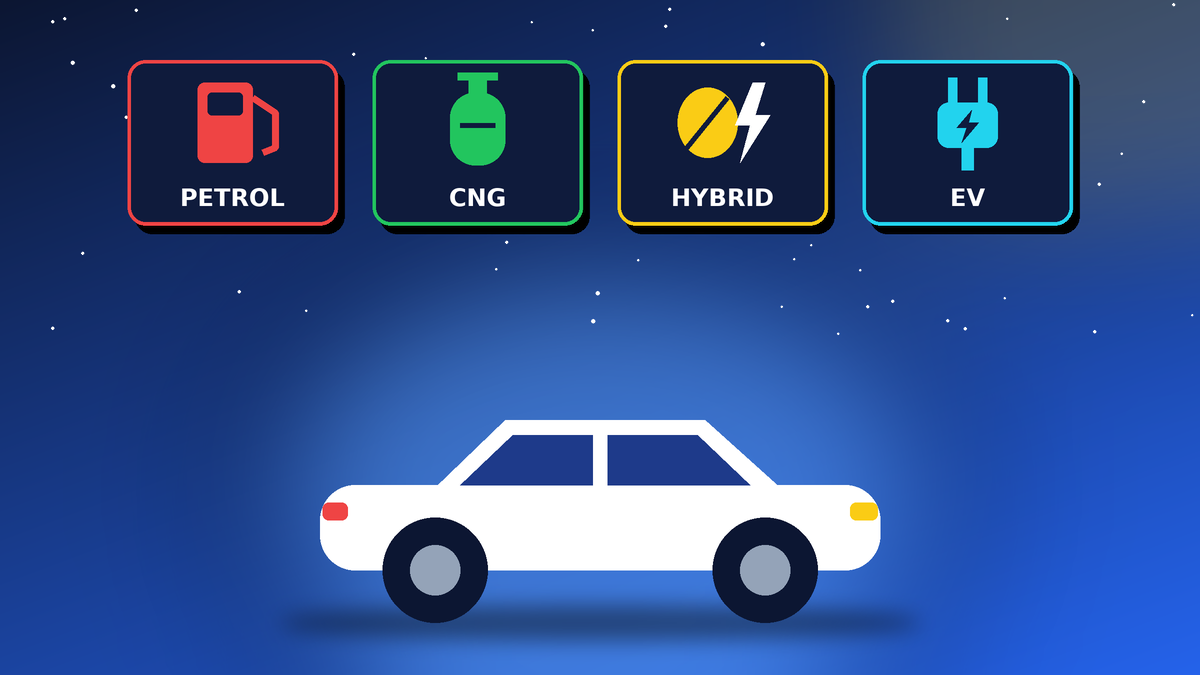
Buying a car in India has never come with so many choices. Walk into a showroom and you’ll be asked whether you want petrol, CNG, a hybrid or an electric car. Petrol vs CNG vs Hybrid vs EV is now the first decision you make, even before choosing a model.
The right answer depends on how far you drive, where you park, whether you can charge at home and how long you’ll keep the car. In this guide, I compare all four on price, running cost, convenience and resale, so you can pick the one that fits your life.
Quick Take
Petrol vs CNG vs Hybrid vs EV, based on how you drive:
- Petrol: best if you drive under about 800 km a month and want the lowest purchase price
- CNG: best for high city mileage on a tight budget, if you can live with less boot space
- Strong hybrid: best for mixed city and highway driving without changing your habits
- EV: best if you can charge at home and mostly drive within the city
- Tax: EVs attract 5% GST; small petrol, CNG and hybrid cars 18%; larger ones 40%
GST rates checked against the Government of India’s press release on 4 October 2026. Fuel and electricity prices vary by city, so use your own local rates in the calculations below.
Table of Contents
Petrol vs CNG vs Hybrid vs EV: The Quick Comparison
Here’s how the four options stack up at a glance. This Petrol vs CNG vs Hybrid vs EV table uses typical figures for compact cars; individual models will differ.
| Factor | Petrol | CNG | Strong hybrid | EV |
|---|---|---|---|---|
| Purchase price | Lowest | Slightly higher | Higher | Highest |
| Running cost | Highest | Low | Medium | Lowest (home charging) |
| Refuelling | Everywhere, minutes | Limited stations, queues | Everywhere, minutes | Home overnight or fast chargers |
| Boot space | Full | Reduced by cylinder | Mostly full | Full |
| Maintenance | Normal | Normal, plus cylinder checks | Normal | Lowest |
| Best for | Low mileage | High city mileage | Mixed driving | City use with home charging |
How the New GST Rates Change the Maths
India’s GST reforms from 22 September 2025 changed car prices in a big way. According to the Government of India’s GST Council announcement:
- Small petrol, CNG and LPG cars (up to 1,200cc and 4 metres long) dropped from 28% to 18% GST.
- Small diesel cars (up to 1,500cc and 4 metres) also dropped to 18%.
- Small hybrids within the same size and engine limits dropped to 18%.
- Larger cars, including larger hybrids, now attract 40% GST.
- Electric cars continue at 5% GST.
The result: small petrol and CNG cars became noticeably cheaper, which narrowed the price gap with EVs. Larger hybrids lost some of their tax advantage, while EVs still enjoy the lowest tax rate.
Some states also offer road-tax or registration waivers on EVs. These vary and change often, so check your state transport department or dealer before you decide.
Petrol vs CNG vs Hybrid vs EV Running Cost: What You’ll Spend Per Month
Running cost is where the four options differ most. Use this simple formula to compare Petrol vs CNG vs Hybrid vs EV costs with your own numbers:
Cost per km = fuel price ÷ mileage. Multiply by the kilometres you drive each month.
Here’s an illustrative example for someone driving 1,000 km a month. The prices and mileage figures are round, realistic assumptions, not quotes for a specific city or car:
| Type | Assumed price | Real-world mileage | Cost per km | Per 1,000 km |
|---|---|---|---|---|
| Petrol | ₹100 per litre | 16 km/litre | ₹6.25 | ₹6,250 |
| CNG | ₹80 per kg | 25 km/kg | ₹3.20 | ₹3,200 |
| Strong hybrid | ₹100 per litre | 24 km/litre | ₹4.17 | ₹4,170 |
| EV (home charging) | ₹8 per kWh | 7 km/kWh | ₹1.14 | ₹1,140 |
| EV (public fast charging) | ₹22 per kWh | 7 km/kWh | ₹3.14 | ₹3,140 |
Two things stand out. First, an EV charged at home costs a fraction of petrol to run. Second, an EV that relies only on public fast chargers costs about the same as CNG, so home charging is what makes EVs really cheap.
Petrol Cars: Simple and Affordable
Petrol is still the easy default. Cars are cheaper to buy, fuel is available everywhere, and there’s nothing new to learn.
- Pros: lowest upfront price, widest choice of models, quick refuelling, strong resale
- Cons: highest running cost, especially in city traffic
Choose petrol if you drive less than about 800 km a month. At low mileage, the fuel savings from other options take too long to cover their higher price.
CNG Cars: The Budget Mileage Champion
CNG is the cheapest way to run a combustion car. Most CNG cars in India are bi-fuel, so you can switch to petrol if you can’t find a station.
- Pros: very low running cost, factory-fitted options from major brands, petrol backup
- Cons: less boot space, slightly lower power, queues at stations, and coverage that is patchy outside cities
Choose CNG if you drive a lot in a city with good CNG coverage, such as Delhi-NCR. Some newer cars use twin smaller cylinders to free up boot space, so check this before you buy.
Hybrid Cars: The Best of Both Worlds?
Not all hybrids are equal. A mild hybrid only assists the engine and saves a little fuel. A strong hybrid can drive on electric power at low speeds, which boosts city mileage significantly.
- Pros: excellent mileage, no charging needed, refuels anywhere, smooth in traffic
- Cons: higher price, fewer models, and larger hybrids now attract 40% GST
Choose a strong hybrid if you do a mix of city and highway driving and can’t charge at home. In any Petrol vs CNG vs Hybrid vs EV decision, the hybrid is the low-stress middle path.
Electric Cars: Cheapest to Run, If You Can Charge
EVs have the lowest running and maintenance costs. There’s no engine oil, no clutch and far fewer moving parts, and regenerative braking reduces brake wear.
- Pros: lowest cost per km with home charging, quiet and quick, lowest GST at 5%
- Cons: highest purchase price, charging takes planning on long trips, and resale values are still settling
Before buying an EV, check three things:
- Home charging: do you have a fixed parking spot where a charger can be installed? Apartment residents need society approval.
- Real range: expect real-world range to be lower than the claimed figure, especially with the AC on.
- Battery warranty: many makers offer long battery warranties, often around 8 years. Read the terms carefully.
You can find public chargers on the government’s e-Amrit portal and in apps from charging networks.
Petrol vs CNG vs Hybrid vs EV: Which One Should You Buy?
Answer these questions honestly, and the Petrol vs CNG vs Hybrid vs EV choice usually becomes clear:
- Can you charge at home? Yes, and you mostly drive in the city: choose an EV.
- Do you drive over 1,500 km a month in a CNG-friendly city? Choose CNG.
- Mixed city and highway driving, with no home charging? Choose a strong hybrid.
- Low mileage and a tight budget? Choose petrol.
- Keeping the car 8 or more years? Lower running costs matter more, which favours EVs and hybrids.
Buying during a festive sale? Our guide on how to spot real festive sale deals applies to car offers too: compare the final on-road price, not the headline discount.
Aadyanix Verdict: Match the Fuel to Your Driving
There’s no single winner in the Petrol vs CNG vs Hybrid vs EV debate. For most city drivers who can charge at home, an EV is now the smartest long-term choice. If you can’t charge, a strong hybrid or CNG car gives you most of the savings without the charging worry.
Petrol still makes sense for low-mileage drivers who want the lowest upfront price. Whichever side of the Petrol vs CNG vs Hybrid vs EV question you land on, calculate your own running cost first and always take a test drive.
Petrol vs CNG vs Hybrid vs EV: Frequently Asked Questions
Is an EV cheaper than a petrol car in the long run?
Usually, yes, if you charge at home and drive regularly. The lower running and maintenance costs can cover the higher purchase price within a few years. If you only use public fast chargers, the savings are much smaller.
In Petrol vs CNG vs Hybrid vs EV, which is cheapest to run?
An EV charged at home has the lowest cost per km, followed by CNG, a strong hybrid and then petrol.
Is CNG better than petrol for city driving?
For high mileage, yes. CNG costs much less per km. The trade-offs are less boot space, slightly lower power and waiting at CNG stations.
What is the difference between a mild hybrid and a strong hybrid?
A mild hybrid only assists the petrol engine. A strong hybrid can run on electric power alone at low speeds, so it saves much more fuel.
What is the GST on electric cars in India?
Electric cars attract 5% GST. Small petrol, CNG and hybrid cars attract 18%, and larger cars attract 40%, following the reforms effective 22 September 2025.
Can I install an EV charger in my apartment?
Usually, yes, but you’ll need permission from your housing society and a dedicated parking spot. Your car dealer can often arrange the installation.
Still unsure about Petrol vs CNG vs Hybrid vs EV for your next car? Get in touch and I’ll be happy to help.