
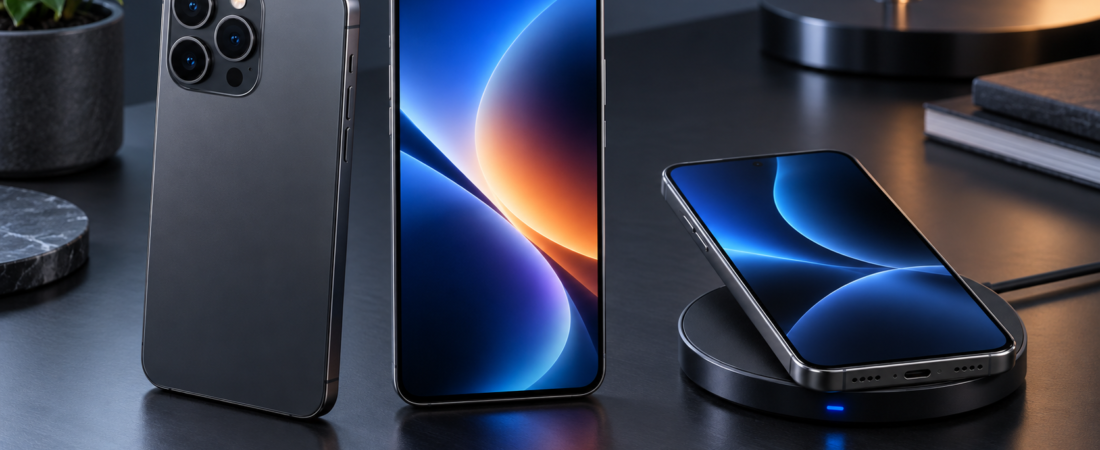
Buying a smartphone in 2026 can be surprisingly complicated.
Manufacturers compete with bigger camera numbers, brighter displays, faster processors and increasingly ambitious AI features. But specifications that look impressive on a product page don’t always translate into a noticeably better experience in everyday use.
For most people, the right smartphone isn’t the one with the longest specification sheet.
It’s the one that gets the things you actually use every day right.
Before spending your money, here are the features that genuinely deserve your attention.
Quick Take
Before buying a smartphone, prioritize display quality, battery life, camera consistency, software support, storage and the overall user experience rather than focusing only on headline specifications.
A good mid-range phone can now be enough for many users, while premium phones make more sense when you specifically value better cameras, stronger performance, premium materials, longer support or particular ecosystem features.
Most importantly, buy for how you actually use your phone — not for specifications you may never notice.
1. Start With Your Budget — But Don’t Automatically Spend It All
The easiest place to start is deciding how much you’re comfortable spending.
But there’s an important difference between:
“My budget is ₹60,000.”
and:
“I need to spend ₹60,000.”
You may discover that a ₹35,000–₹45,000 phone already handles everything you need.
Modern mid-range smartphones can offer excellent displays, capable processors, good cameras, fast charging and enough performance to remain useful for years.
Premium phones still have advantages, but the improvements become increasingly incremental as prices rise.
Ask yourself
What does the more expensive phone actually give you?
A meaningfully better camera?
Longer software support?
Better durability?
A feature you genuinely use?
Or simply a more premium specification sheet?
Spend more when the additional features matter to you — not simply because your budget allows it.
2. Don’t Judge Performance by the Processor Name Alone
Smartphone processors receive enormous attention, particularly during new product launches.
They’re important, but most people don’t need the fastest chip available.
For messaging, social media, streaming, navigation, photography, banking and everyday applications, a capable modern mid-range processor can already provide excellent performance.
More powerful processors matter more if you regularly:
play demanding games
edit high-resolution video
perform intensive multitasking
use demanding AI or creative applications
plan to keep the phone for many years
There’s another factor that specification sheets don’t always reveal: sustained performance.
A processor can perform extremely well for a short benchmark but slow down when the device becomes hot.
What matters more
Look at real-world performance, thermal behaviour and efficiency rather than relying on benchmark numbers alone.
For most users, smooth and consistent performance is more valuable than winning a benchmark test.
3. The Display Is One of the Most Important Features
You interact with your phone’s screen every time you use it.
That makes display quality far more important than many specifications buried deeper in the product page.
A good smartphone display should offer:
sufficient brightness for outdoor use
good colour reproduction
comfortable viewing angles
smooth scrolling
appropriate resolution for its size
High-refresh-rate displays — commonly 90Hz or 120Hz — can make scrolling and animations feel noticeably smoother than traditional 60Hz screens.
But refresh rate alone doesn’t determine display quality.
Brightness, colour accuracy, touch responsiveness and power efficiency also matter.
What to look for
If possible, see the phone in person.
Take it near a bright window or outside a store. Scroll through a webpage. Watch a video. Reduce the brightness.
The screen is something you’ll potentially look at for several hours every day.
It deserves more attention than many buyers give it.
4. Battery Life Matters More Than Battery Capacity
A larger battery doesn’t automatically mean longer battery life.
Battery endurance depends on several factors, including:
battery capacity
processor efficiency
display size and brightness
software optimization
network conditions
your usage patterns
Two phones with similar battery capacities can deliver noticeably different real-world endurance.
That’s why independent battery testing can be more useful than simply comparing milliamp-hour figures.
Charging matters too
Fast charging can be extremely convenient, particularly if you frequently need to top up your phone during the day.
But don’t look only at the advertised peak charging wattage.
Also check whether the required fast charger is included, how long a full charge actually takes and whether features such as wireless charging matter to you.
The best battery experience is the one that fits your routine.
5. Camera Megapixels Don’t Tell You Which Camera Is Better
A 200-megapixel camera isn’t automatically better than a 50-megapixel camera.
Smartphone photography depends on much more than resolution.
Sensor quality, lens quality, image processing, stabilization, autofocus, HDR processing and computational photography can all have a major impact on the final photograph.
Instead of comparing megapixel numbers, look at actual photographs taken by the phones you’re considering.
Pay particular attention to:
people and skin tones
moving subjects
low-light photographs
indoor photography
video stabilization
zoom quality
front-camera quality
A smartphone camera should also be consistent.
A camera that occasionally produces an amazing photograph but frequently struggles with moving subjects may be less useful than one that reliably produces good results.
Think about the cameras you’ll actually use
An additional camera isn’t automatically valuable.
A good telephoto camera may matter far more to you than a low-resolution macro camera included mainly to increase the number of lenses on the back.
Buy the camera system, not the camera count.
6. Software Support Can Determine How Long Your Phone Remains Useful
Software support has become one of the most important smartphone buying considerations.
Some current smartphones now offer support periods extending as long as seven years. Google says Pixel 8 and later devices receive seven years of OS and security updates, while Samsung promises seven generations of OS upgrades and seven years of security updates for its Galaxy S26 series.
That doesn’t mean every smartphone offers the same commitment.
Before buying, check:
How many major operating-system upgrades are promised?
How long will security updates continue?
How frequently does the manufacturer normally deliver them?
This becomes especially important if you plan to keep your phone for four, five or more years.
Why this matters
A phone can still have perfectly capable hardware when poor software support makes it increasingly outdated.
Longer support can therefore make a slightly more expensive phone better value over its lifetime.
7. Choose Enough Storage for the Next Few Years
Storage requirements tend to increase over time.
Photos become larger.
Videos consume significant space.
Apps grow.
Offline downloads accumulate.
Messaging applications collect years of media.
If you’re already struggling with storage on your current phone, buying another device with the same capacity may recreate the problem surprisingly quickly.
For many buyers, 128GB can still be sufficient, particularly if they use cloud storage and don’t record large amounts of video.
But 256GB can provide considerably more breathing room if you take lots of photographs and videos, download media or intend to keep the phone for several years.
Don’t assume you can expand it later
Many modern smartphones don’t support microSD cards.
Check before buying.
Storage is one of the few smartphone specifications that may be impossible to upgrade later.
8. RAM Matters — But More Isn’t Always Better
RAM helps your phone keep applications available in memory and handle multitasking.
But just like megapixels, the number alone doesn’t tell the entire story.
Software optimization also matters.
For mainstream Android smartphones in 2026, 8GB of RAM is a sensible starting point for many users. More can be useful for demanding multitasking, gaming, advanced AI features or keeping a device for a long time.
But don’t automatically assume that a phone with 16GB is twice as fast as one with 8GB.
It isn’t.
Look at the complete experience rather than treating RAM as a performance score.
9. AI Features Are Useful — But Don’t Buy a Phone Just for the AI Label
AI has become one of the biggest smartphone marketing themes.
Modern phones can use AI for tasks such as:
photo editing
translation
transcription
summarization
search
voice assistance
image generation
contextual recommendations
Some of these features can be genuinely useful.
Others may be features you try twice and forget about.
AI is also increasingly integrated into current Android devices rather than being limited to a separate chatbot experience; Google’s current Android phone lineup prominently emphasizes Gemini capabilities, while Samsung’s Galaxy S26 family integrates multiple AI features and agents.
Ask one important question
Would I still buy this phone if the AI marketing disappeared from the box?
If the answer is no, make sure those AI features genuinely solve a problem you have.
Core smartphone fundamentals still matter more.
10. Durability Is Easy to Ignore Until Something Breaks
Smartphones are expensive objects that we carry everywhere.
Yet durability often receives less attention than processor speeds or camera specifications.
Check features such as:
water and dust resistance
screen protection
frame and back materials
repairability
service availability
replacement-part costs
warranty coverage
An IP67 or IP68 rating can provide additional protection against accidental exposure to water and dust, although it shouldn’t be treated as permission to deliberately use the phone underwater.
Cases and screen protectors can also be sensible investments, particularly on phones with expensive curved or large displays.
11. Think About the Ecosystem Around the Phone
A smartphone rarely exists alone anymore.
You may also own:
wireless earbuds
a smartwatch
a tablet
a laptop
a television
smart-home devices
Some features work particularly well when multiple devices come from the same ecosystem.
That shouldn’t automatically lock you into one brand, but it deserves consideration.
Switching platforms may mean losing certain conveniences or replacing accessories.
Before moving from Android to iPhone — or the other way around — think beyond the smartphone itself.
Ask what happens to your watch, cloud storage, paid apps, passwords, photo library, messaging habits and other connected devices.
12. Don’t Ignore the Small Things
Specification comparisons often focus on major hardware.
But small details can have a surprisingly large impact on everyday satisfaction.
Before buying, check:
speaker quality
haptic feedback
fingerprint or face unlock reliability
call quality
proximity sensor behaviour
USB capabilities
eSIM support
Wi-Fi and Bluetooth standards
included accessories
after-sales service
None of these features may sell a smartphone on their own.
Together, however, they can determine whether the device feels polished or frustrating.
A Simple Smartphone Buying Checklist
Before buying your next phone, answer these questions:
1. What is the maximum amount I’m comfortable spending?
2. What are the three things I use my phone for most?
3. How important is the camera to me?
4. Do I need strong gaming or intensive performance?
5. How much storage am I currently using?
6. How long do I intend to keep the phone?
7. How many years of software support does it receive?
8. Is battery life or charging speed more important to me?
9. Do I already own devices in a particular ecosystem?
10. What does the more expensive alternative actually give me?
If you can answer those ten questions, your shortlist usually becomes much smaller.
Aadyanix Verdict
The smartphone market encourages buyers to compare numbers.
Megapixels.
Gigahertz.
Charging watts.
RAM.
Peak brightness.
Benchmark scores.
But the best smartphone isn’t necessarily the device with the biggest numbers.
It’s the phone that best matches the way you actually use it.
For most buyers, prioritize a good display, dependable battery life, consistent cameras, sufficient storage, reliable performance and long software support.
Then decide which premium features genuinely matter to you.
A smartphone is something you may use several hours every day for the next three to five years.
Choose the experience you’ll live with, not the specification sheet you’ll stop looking at a week after buying it.
Frequently Asked Questions
How much should I spend on a smartphone in 2026?
There isn’t one correct amount. Modern mid-range smartphones can satisfy many users, while premium phones are more worthwhile when you specifically value features such as advanced cameras, high-end performance, premium materials or particular ecosystem capabilities. Start with your requirements rather than a price category.
Is 128GB enough storage in 2026?
It can be sufficient for users who don’t store large amounts of video or offline media and regularly use cloud storage. If you take many photos and videos or intend to keep the phone for several years, 256GB can provide more comfortable headroom.
Is 8GB RAM enough for an Android phone?
For many mainstream users, 8GB remains a sensible amount for everyday applications and multitasking. Heavy gaming, advanced workloads or long-term use may justify more, but RAM capacity alone doesn’t determine how fast a phone feels.
Does a higher-megapixel camera mean better photos?
No. Megapixels describe image resolution, not overall camera quality. Sensor size, lenses, image processing, stabilization, autofocus and computational photography all influence the final result.
How important are software updates?
Very important if you plan to keep your phone for several years. Updates provide new features, compatibility improvements and security fixes. Support periods vary substantially between manufacturers and individual models.
Should I buy a phone mainly for its AI features?
Usually not. AI capabilities can be useful, but they should complement strong fundamentals such as display quality, battery life, cameras, performance and software support. Consider whether the AI features solve problems you genuinely encounter.